
TM
Copper production process from ore to cathode


1. Mining
-
Copper ores are extracted from open-pit or underground mines.
-
The most common copper-bearing minerals are chalcopyrite (CuFeS₂), bornite (Cu₅FeS₄), and malachite (Cu₂CO₃(OH)₂).
-
Ore grades are typically low, often less than 1% copper
2. Crushing and Grinding
-
The mined ore is transported to a concentrator.
-
It is crushed and then ground into fine particles to liberate copper minerals from the surrounding rock.
3. Concentration (Flotation)
-
The ground ore undergoes froth flotation.
-
Reagents are added to make copper minerals hydrophobic.
-
Air bubbles carry copper-rich particles to the surface, forming a froth that is skimmed off.
-
The result is copper concentrate, typically containing 20–30% Cu.
4. Smelting
-
Concentrate is dried and fed into a smelter (flash furnace or reverberatory furnace).
-
At high temperatures, sulfides are oxidized, producing matte (a mixture of copper, iron sulfide, and other impurities).
-
Slag (waste material) is removed.
-
The matte usually contains 50–70% Cu.
5. Converting
-
The matte is transferred to a converter furnace.
-
Air or oxygen is blown through to oxidize iron and sulfur.
-
The product is blister copper, about 98–99% pure, with a blistered surface due to escaping sulfur dioxide gas.
6. Fire Refining
-
Blister copper is further refined in a refining furnace.
-
Impurities are removed, producing anode copper (~99% purity).
-
Large copper plates (anodes) are cast for electrorefining
7. Electrorefining
-
Anodes are suspended in tanks containing an acidic copper sulfate solution.
-
A thin sheet of pure copper serves as the cathode.
-
When electric current passes through:
-
Copper dissolves from the anode into solution.
-
Pure copper plates onto the cathode.
-
Impurities either fall off as anode slime (containing precious metals) or remain in solution
-
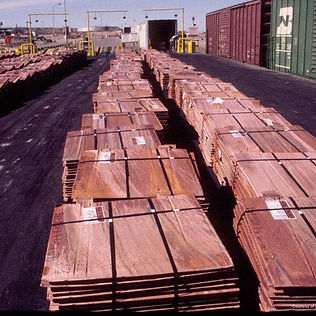
8. Final Product – Copper Cathodes
-
The cathodes are 99.99% pure copper.
-
They are removed, washed, and packaged for sale.
-
Cathodes are the standard form traded globally (LME Grade A copper).
-
They serve as feedstock for wire, rods, tubes, sheets, and alloys.