
TM
Aluminum production from ore to ingot


.jpg)
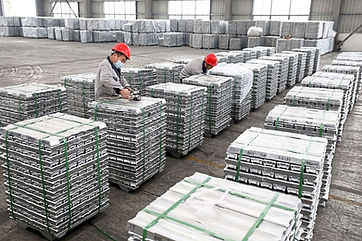
Main Stages of Aluminum Production
1. Mining Bauxite
-
Bauxite is the primary ore, rich in aluminum oxide (30–70%).
-
It is extracted through open-pit mining and crushed into fine particles.
2. Bayer Process – Producing Alumina (Al₂O₃)
-
Crushed bauxite is treated with sodium hydroxide (NaOH) under high pressure and temperature.
-
Aluminum oxide dissolves, while impurities (iron, silica, titanium) remain as “red mud.”
-
The solution yields aluminum hydroxide (Al(OH)₃), which is then calcined (heated to ~1000 °C) to form alumina (Al₂O₃).
3. Hall-Héroult Electrolysis – Reducing Alumina
-
Alumina is dissolved in cryolite (Na₃AlF₆), which lowers the melting point.
-
Electrolysis occurs in large cells:
-
Cathode (carbon lining): aluminum ions are reduced → molten aluminum collects at the bottom.
-
Anode (carbon blocks): oxygen reacts with carbon → releases CO₂.
-
-
This step is energy-intensive, consuming ~13–15 MWh per ton of aluminum.
4. Molten Aluminum Collection
-
Pure aluminum (99.7%) accumulates at the bottom of the electrolytic cell.
-
It is periodically siphoned off and transferred to casting facilities.
5. Casting Aluminum Ingots
-
Molten aluminum is poured into molds and cooled.
-
The result: ingots, the standard form for further processing (rolling, extrusion, alloying).
-
Ingots are then used across industries: construction, transportation, aerospace, packaging, and consumer goods.
Key Notes
-
Energy demand: Electrolysis is the most costly stage, so smelters are often located near cheap electricity sources.
-
Environmental impact: Bayer process generates red mud, a major waste management challenge.
-
Recycling advantage: Secondary aluminum requires only ~5% of the energy compared to primary production.
